
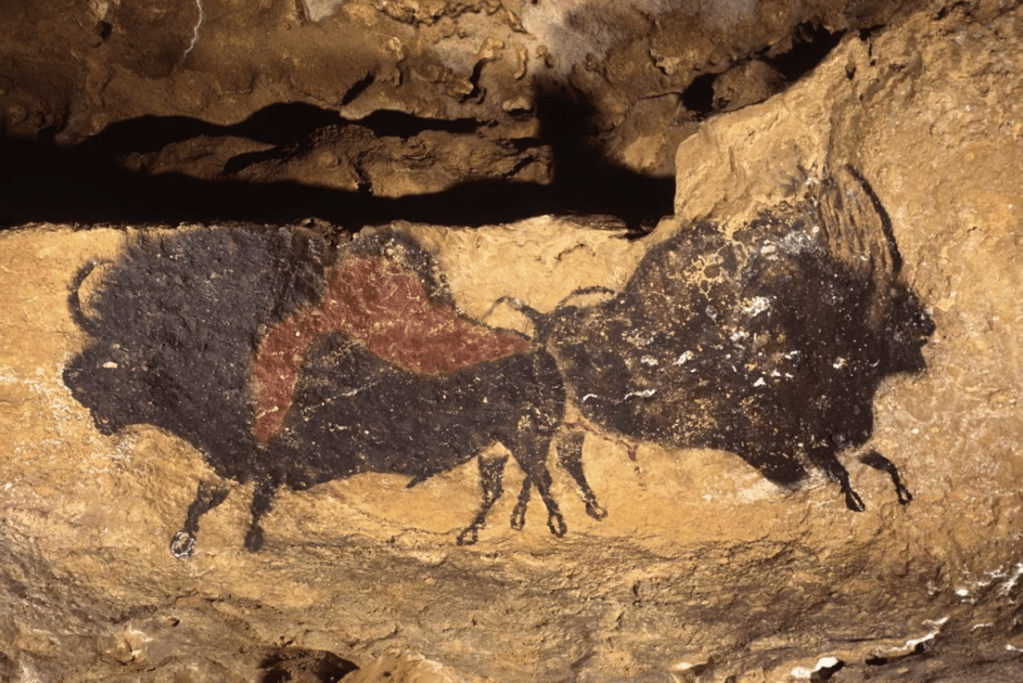
There’s something humbling about standing in front of art that’s 20,000 years old. Even when you know it’s a replica, the experience of visiting Lascaux IV near Montignac in the Dordogne leaves you quiet and contemplative.
The modern building sits dramatically in the landscape, all glass and concrete, a stark contrast to the ancient cave art it protects and presents. The original Lascaux caves were discovered in 1940 by four teenagers and a dog—Robot, a terrier—who followed him down a hole. It’s one of those perfect stories of accidental discovery that makes you believe in fate. The caves were opened to the public but closed again in 1963 when it became clear that human breath and presence were damaging the prehistoric paintings. What we can visit now is Lascaux IV, opened in 2016, the most complete and accurate replica ever created.
The tour begins with a descent into the replica cave, and despite knowing it’s a reproduction, the effect is immediate and powerful. The temperature drops. The darkness feels ancient. And then you see them: hundreds of animals flowing across the walls. Horses, aurochs, deer, and that mysterious unicorn figure that has puzzled experts for decades.
What struck me most was the sophistication of the art. These weren’t crude stick figures. The artists used the contours of the rock to give their animals dimension and movement. A bulge in the limestone becomes a horse’s muscular haunch. The paintings seem to dance in the flickering light, just as they would have by torchlight 20,000 years ago.
The Hall of the Bulls is the showstopper—a sweeping frieze of massive aurochs, some over five meters long. Standing beneath them, I felt a connection across millennia. These people looked at the same stars I do, walked the same river valleys, loved their children, told stories.
After the cave replica, the museum upstairs provides context—how the paintings were made, what pigments were used, theories about why they were created. Interactive displays let you try your hand at prehistoric painting techniques (harder than it looks). There’s also a section on the painstaking work of creating the replica, which is fascinating in its own right.

Practical notes:
- Book your tickets online in advance, especially in summer.
- Tours are timed and in small groups, which keeps the experience intimate.
- Allow at least two hours for the full visit.
Lascaux reminds us that the urge to create, to leave a mark, to say “I was here” is deeply, fundamentally human. It’s been with us for 20,000 years. It’s a thought that stays with you long after you leave the museum.

 gascony girl